Bowel movement after surgery
From rat bowel-movement measurements to a tolerated meal in adults, the movement experiments become increasingly practical—and harder to satisfy.
The surgical rat model
Postoperative ileus describes impaired bowel movement after surgery. In a rat model involving laparotomy and intestinal manipulation, repeated intravenous ipamorelin increased cumulative faecal output, food intake and body-weight gain over 48 hours compared with vehicle. A single dose shortened the time to the first bowel movement.
These are refreshingly physical outcomes. Material moves through an animal; eating resumes; the balance changes. I see considerable appeal in those concrete changes. Bowel recovery seems a more substantial clinical ambition than a growth-hormone measurement alone.
A review of ghrelin’s gastrointestinal actions describes how high-dose ghrelin and synthetic ghrelin-receptor agonists stimulate gastric motility, increase gastric tone and emptying, and enhance migrating motor complexes. That is a wider class rationale for investigating movement through the stomach. The rat ipamorelin experiment gives a particular compound and surgical model their place within it.
Meal tolerance in adults
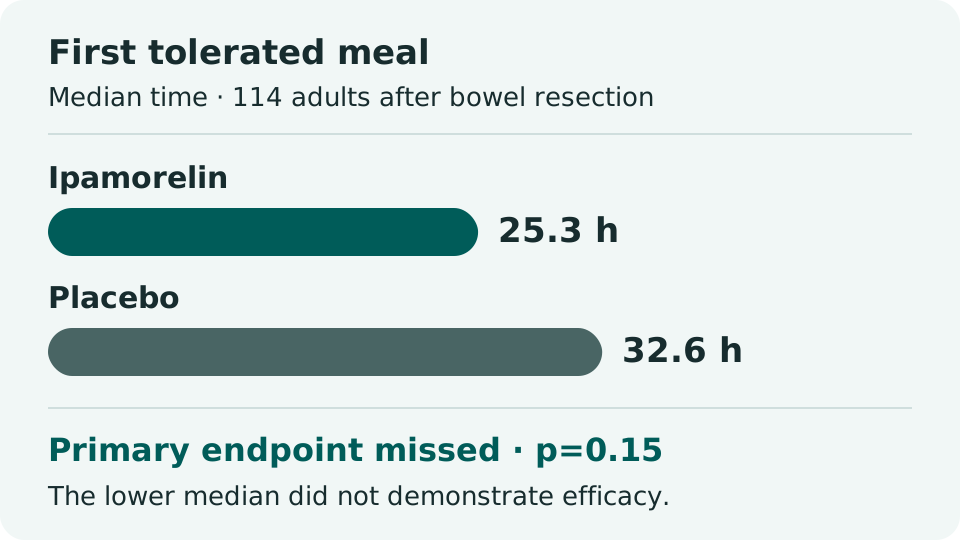
The randomized proof-of-concept trial involved 114 adults undergoing open or laparoscopic bowel resection. Median time to the first tolerated meal was 25.3 h with ipamorelin and 32.6 h with placebo, with p=0.15. The primary endpoint was missed; efficacy was not demonstrated.
The lower median is tempting. I understand the urge to turn it into an encouraging headline, especially after the animal experiments. But the trial’s result includes the unsuccessful primary analysis, and I cannot honestly promote the more attractive bar while leaving that analysis behind. The chart holds both parts together.
The perioperative safety window
In that same short perioperative trial, treatment-emergent adverse events occurred in 87.5% of the ipamorelin arm and 94.8% of placebo. The study found no ipamorelin-specific safety signal in its short observation window. Those figures describe adults recovering from bowel surgery and the events recorded in that setting.
That unfulfilled ambition still feels worth investigating. Eating after surgery is an intelligible clinical ambition, and the animal work supplied reasons to test it. The published test still leaves that ambition unmet. Sensitivity and vomiting return to other questions that a meal-tolerance endpoint cannot settle.